
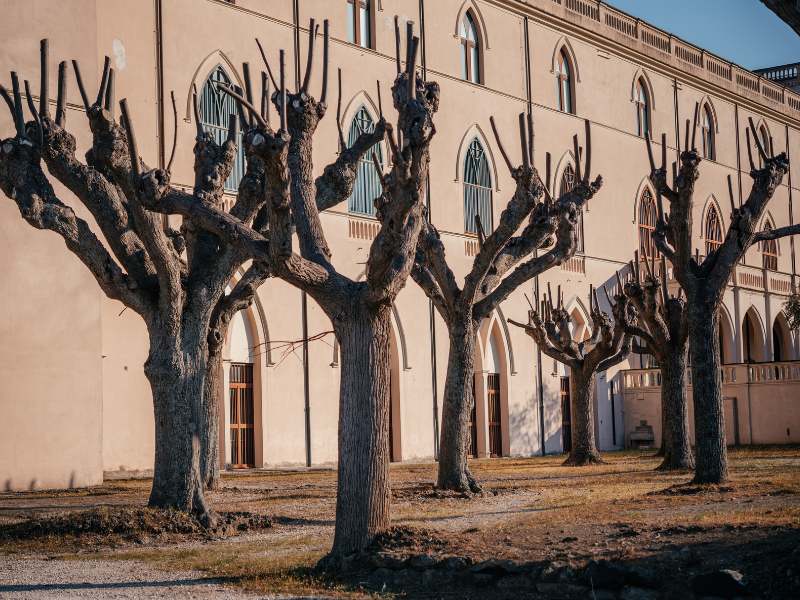
Tree topping and pollarding aren't the same job. One is a proper pruning system that has kept British trees safe for hundreds of years; the other cuts through thick wood in the wrong place and can shorten a tree's life by decades.
Quick answer: pollarding cuts limbs back to the same points on a regular cycle, usually starting on young trees. Topping hacks thick limbs or the main trunk down to stubs on wood that's already mature, with no plan behind the cuts. Pollarding keeps trees healthy long term; topping weakens them, often for good. A certified arborist will almost always recommend pollarding over topping for a large, overgrown specimen.
This guide covers what each method involves, the legal risk of getting it wrong, what pollarding costs, and how to spot overgrown trees or topped trees needing attention.
Tree topping means cutting large branches, or the upper branches and main trunk, down to blunt stubs. It ignores the tree's natural growth patterns and basic tree management, and just makes the tree shorter, fast.
Tree topping is widely discouraged across the UK arboriculture industry. Professional arborists recommend pollarding or proper crown work instead, since topping ignores proper pruning techniques and can weaken a tree badly, raising the risk of decay and dangerous regrowth. It's a basic difference in how the tree responds to pruning, not a style preference among tree surgeons.
Topping strips away most of a tree's crown in one go, triggering a stress response: stored energy in the roots pushes out a mass of new shoots right at the cut. These shoots grow fast but stay barely attached, clinging to the surface rather than the wood. A year or two of new growth later, high winds can snap them clean off.
The bigger problem is the cuts themselves: indiscriminate cutting at a random point rather than a natural branch union, often leaving the remaining branches loosely fixed to what's left of the crown. Large wounds like this rarely seal, leaving fungi and decay an open door into the heartwood. A tree struggles to compartmentalise a wound that size; structural integrity erodes from the inside long after the outside looks fine.
Topped trees need to be cut every few years again, since the weak regrowth has to be managed. That's why topping often costs more over time, not less. It looks like a quick fix. It isn't one.

Pollarding is a controlled pruning system: branches are cut back to the same fixed points, called pollard heads, on a set cycle, giving good tree care without letting a specimen outgrow its space. Done properly, it keeps a tree at a manageable size for life without risking its health.
The practice dates back to medieval Britain, when pollarding harvested timber, firewood, fencing material, and animal fodder from the same tree, over and over. Cutting the limbs up high, above the reach of grazing animals, protected the tender shoots so the tree kept producing usable wood for generations, a form of tree care older than most of our buildings.
Pollarding starts early, usually between five and ten years old. A tree surgeon picks a height and makes the first heading cut on the main branches, creating the first pollard heads, the knuckle-like points from which all future growth comes.
Most pollarded trees are cut back to the same cut points every one to three years, in the dormant season. New growth emerges from the pollard heads and the young shoots grow rapidly through spring and summer, since the tree still has a full root system supporting a much smaller crown. Every heading cut lands on the same point, year after year.
Skip a few cycles and the problem compounds. Every missed heading cut means the new growth gets thicker, so eventually someone removes large limbs instead of thin fresh shoots, meaning bigger wounds and slower healing. Regular maintenance is what makes pollarding safe; skipped cycles can make it almost as risky as topping.
Not every species responds well to this kind of pruning. Certain species heal fast and tolerate heavy cuts far better than others, each following its own growth pattern once established as a pollard:
Growth rate also plays a part in deciding how tight the cycle needs to be, since willow often needs cutting back more often than a slower species like oak. A certified arborist will assess age and condition before deciding which method suits pruned trees best.

The damage from topping doesn't always show up straight away. A newly topped tree can look fine for a season or two, but underneath, it's different.
Topped trees are more likely to develop disease and decay because the large wounds left behind rarely heal properly. Fungi get in through these entry points and spread through the wood for years before any outward sign appears, by which time structural integrity can be badly compromised, and long-term health suffers.
The new shoots that grow back after topping are the other big risk: poorly attached to the trunk, they can snap during storm damage or strong gales, bringing down whole limbs. That raises real liability concerns for property owners with large trees near a house, driveway, or public footpath.
In the worst cases, topped trees simply die. Removing most of the crown at once can starve a tree of energy, and combined with large open wounds and other environmental stresses, some never recover. Others survive but stay in decline, needing constant maintenance to stay safe. Many homeowners only find this out years after the original cut, once it's already expensive.
Done properly, pollarding doesn't just avoid the risks of topping; it can genuinely extend how long a tree lives. Repeated pollarding keeps the crown lighter than it would grow unchecked, reducing strain on the trunk and root system over decades and supporting long-term tree health across a specimen's whole life.
Some of Britain's oldest living trees are historic pollards. Ancient oaks, beeches, and limes have survived for centuries because pollarding kept their crowns light enough that the structure never carried more weight than it could handle. Pollarded trees managed this way tend to outlive specimens left to grow unchecked, often by a wide margin.
Epping Forest is the best-known example of historic pollarding in the UK. Thousands of trees were pollarded regularly until the late 19th century; once that stopped, many kept growing into the strange, hollowed shapes people recognise today. Pollarding isn't just British either; several European cities use the same technique along boulevards and old parks.
Those old pollards are more than just interesting to look at. Veteran pollarded trees develop hollows, deadwood and decaying cavities as they age, supporting hundreds of species of fungi, beetles, lichens, birds and bats. A tree that would look messy to some eyes is actually one of the richest habitats in a British woodland.
Woodland covers around 13% of the UK's land area, and England alone has over three million hectares, making it one of the least densely wooded countries in Europe. Research published in 2025 found fewer than 3% of urban neighbourhoods in England reach the recommended 30% tree canopy cover. Keeping mature trees alive through proper pruning, rather than replacing them with young trees, does more for tree health, carbon sequestration and local wildlife than most realise.
Pollarding isn't just a historic curiosity; it's still one of the most common tools for managing tree size in UK towns and cities, working especially well in urban settings where space is tight.
The UK had a population of over 69 million people by 2024, putting pressure on urban green space. London boroughs and councils rely on pollarding to keep street trees clear of power lines, control tree size along busy highways, and manage large specimens in tight urban spaces where there isn't room for a tree to reach full size. Across urban areas, it remains one of the most reliable ways to manage overgrown trees safely.
Instead of removing mature trees that have outgrown their space, councils and site managers can pollard them on a proper cycle and get decades more life from the same tree. Pollarded trees on a proper schedule rarely become a safety issue. Good tree management means choosing the right method before problems start, not after.
Prices vary depending on a tree's size, species, location, and access. A straightforward pollarding job on a smaller specimen, under about six metres, tends to fall between £200 and £600. Larger, established trees needing specialist access equipment can run from around £600 up to £1,200, and particularly large or awkward jobs go higher still.
The average cost of pollarding a tree in the UK sits around £600 to £700 for a typical mid-sized job, though smaller and larger jobs pull that number in either direction. Regular tree pruning, less intensive than pollarding, tends to cost less, often between £100 and £500. Pruning like this is skilled work, and the price reflects the training and insurance involved. Many homeowners find budgeting for tree care on a regular cycle cheaper than emergency work later.
The price is a rough guide, and the actual cost varies depending on tree size, condition, access and location. Always get a proper quote from a qualified tree surgeon or experienced tree services company before agreeing to work, particularly on big, mature specimens.

Not every tree can be cut back whenever an owner feels like it. Many mature trees, especially in conservation areas or with real heritage value, are protected by a Tree Preservation Order, usually shortened to TPO.
Unauthorised work on a tree protected by a TPO, including topping it, can lead to a fine of up to £20,000 in the magistrates' court, and an unlimited fine in the Crown Court for serious cases. Pruning without checking a tree's status first is how most TPO breaches happen, a real risk when hiring cheap, unchecked labour to tidy up large branches.
Government-backed reviews in 2025 recommended stronger protection for ancient and heritage trees, including a national register of important trees and tighter legal safeguards, following several high-profile losses of notable old specimens. Anyone responsible for a mature or veteran tree should check its protected status with the local council before any pruning work, topping included.
Reputable tree surgeons follow British Standards for tree work, commonly known as BS3998, and many hold certification through the International Society of Arboriculture. Trees maintained properly under these standards rarely end up as a liability, so it's worth checking before hiring anyone to work on large trees or anything protected.
Pollarding isn't always the right answer. Depending on the species, age, and condition of the specimen, an arborist might recommend a different pruning technique. Choosing the right pruning technique from the start saves years of extra work, and pruning decisions should start there, not with the size of the job.
This cuts back the ends of branches to reduce a tree's size while keeping its natural shape roughly intact. It's a common choice for a mature tree that's grown too large for its space but was never trained as a pollard young. When comparing tree topping vs crown reduction, crown reduction is the preferred method because it preserves the tree's health and structure. Done well, crown reduction pruning uses proper techniques, cutting back to a lateral branch or a suitable point rather than a bare stub, so the wound heals well, and the structure stays strong.
Crown thinning takes a different approach: instead of shortening limbs, it removes a proportion of the smaller branches through selective pruning, spread evenly through the canopy at sensible cut points, letting more light and air through without changing a tree's size much. It's often used to cut wind resistance on a large, dense head of foliage, lowering the risk of storm damage without the drastic look of a heavy reduction.
The main difference between these methods and topping comes down to where the cuts are made. Crown reduction, crown thinning and pollarding all follow arboricultural practices set out in British Standards, cutting at natural points so the tree can heal and keep growing safely. Topping ignores that and removes large portions of the tree wherever it happens to end up.

If a previous owner or a cheap contractor has already topped a tree, there isn't a quick fix, but topped trees like this can usually be brought back through careful, patient work. An arborist can work with what's there through crown restoration, gradually selecting the strongest of the new branches and removing the weaker, loosely fixed ones over several years, slowly rebuilding a strong structure instead of leaving weak, tangled regrowth to develop on its own.
For sizeable, mature specimens or work close to a building, road, or power line, get a professional opinion before any cutting takes place. A quick check on whether the tree falls under a TPO or sits inside a conservation area can save trouble later, and a proper survey will tell you which pruning technique is right for that particular tree.
This guide was put together by the team at GRO Treecare, drawing on recognised arboricultural guidance and years of hands-on pruning work across the UK.